Our heritage
The story, the legend, the grain
Following kalanamak rice through the Terai, the stories people tell and the fields that remain.
Sidhartha’s Journal4 min read

Imagine a path through the Terai in the early morning. There is water in the fields, a softness in the light and the everyday work of growing food. If I were walking beside you, this is where I would begin the story of kalanamak rice: with a place, not a palace; with a crop, not a crown.
kalanamak rice has long been associated with Siddharthnagar and the surrounding belt of eastern Uttar Pradesh. People in the region have cultivated and remembered it across generations. Its natural fragrance and soft cooked texture give it a recognisable character, while its connection to the land gives it a cultural one. To understand this rice, it helps to make room for both.
The story people carry
You may hear kalanamak rice called “Buddha Rice.” The Siddharthnagar landscape includes sites associated with ancient Kapilavastu and the life of Gautama Buddha. Local tradition links the rice to him, and one telling describes him sharing seeds with villagers. It is a beautiful story about food, generosity and a community’s memory.
It is important to call it what it is: a local legend. We cannot point to a kitchen ledger from that time and prove the exact exchange of seeds or the words spoken. A legend does not become more meaningful when we pretend it is a documented fact. It tells us what people have chosen to remember and pass on. In this case, the tale keeps the grain connected to the place and to an idea of sharing nourishment.
The history we can discuss more firmly is the region’s longstanding cultivation of kalanamak rice. The district administration describes its presence since the Buddhist period. Today the rice is recognised through a registered geographical indication, and Siddharthnagar identifies it as a signature local product. The official record does not make the legend literal, but it does show that the grain’s link to this region is far more than a recent marketing invention.
A crop that nearly slipped from view
Heritage does not mean an unbroken line of easy harvests. According to the Siddharthnagar district administration, kalanamak rice occupied more than a tenth of the district’s rice area until the 1990s, then fell to less than half a percent by 2002. Lower yields helped push growers towards other varieties. That is a reminder that the survival of a food tradition depends on practical choices made by farmers, not only on admiration from people at the dinner table.
The district also reports renewed cultivation in more recent years, supported by seed work, field demonstrations and promotion. A revival is not the work of one brand or one storyteller. It involves growers, researchers, local institutions, traders, cooks and households willing to bring the rice home. Sidhartha’s part is to make this grain easier for more people to encounter, understand and enjoy.
I hope that as interest grows, the people doing that work remain visible in the story. A photograph of a farmer or a pair of hands sorting rice is more than atmosphere. It is a chance to ask who grew the crop, what careful work followed the harvest and how the grain reached the person cooking it.
Why an old story belongs in a modern kitchen
It is tempting to imagine that people in ancient times ate kalanamak rice for the same nutritional reasons we might discuss today. We cannot know that. What we can say is simpler and more human: rice fed households. This particular rice became known for its aroma and character, and people kept its story alive even as cultivation changed. The first benefit of any staple was that it helped make a meal.
Now our questions are different. We ask where a food comes from, how it is grown, how it tastes and what evidence says about its composition. Those questions belong beside the old stories, not inside them. I would rather invite you to hold both: the tradition that gives kalanamak rice a sense of belonging and the careful curiosity that helps us make choices today.
So when the rice begins to steam in your kitchen, think of the journey it took to get there. A field in the Terai. Farmers choosing what to grow. A legend retold around tables. A meal being made in your own home. History is not only something we look back at. Sometimes it arrives with dinner.
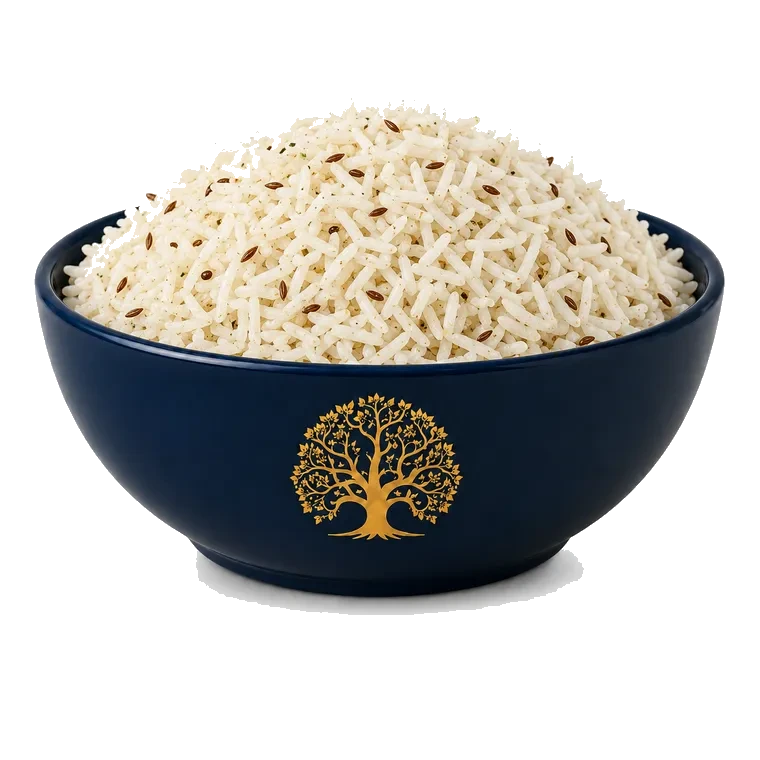
I cannot send the smell through this page. I can only invite you to make the smallest experiment yourself. Rinse the grain. Set the pot on the stove. Let the kitchen do what kitchens do. When somebody walks in and asks what is cooking, you will have your answer.
It is kalanamak rice. And yes, it really does smell like that.